
YES!! COURT SPANKS ADMINISTRATION AND STANDS THEM IN A CORNER OVER ATTEMPT TO INTERFERE WITH ELECTIONS
I keep telling you that he can’t interfere with elections. Some of you seem not to believe me, so maybe you will believe a Federal court (actually a *second* Federal court). (Hey, bookmark this post so that you can refer back to it when you see someone else saying “if there even are any elections.”)
Some months ago Trump issued that executive order a) trying to impose on the states a deadline by which mail-in ballots must be counted (not postmarked, *counted*, they already have to be postmarked by Election Day), and b) demanding that a citizenship question be put on voter registration forms.
To cut to the chase, the Court said “Are you gargling with bong water? Everybody knows that elections, including Federal elections, are run *by the states*! Begone with your ridiculous selves!”
Ok, the Court didn’t really say that, but they may as well have, in legalese. What they really said was “Separation of powers, Constitution’s Elections clause, Constitution’s Electors clause, and application of the 10th Amendment thereto.”
What you’ll find if you read the decision (75 pages and included for Notes from the Front members) is that the Court does a masterful job of teasing out from the long, convoluted executive order, where the EO infringes on things which are reserved to the states, and where the EO talks about things which are allowed for the Federal government (for example looking at *public* voter records). Similarly, the administration cannot force the states to change their voter registration forms, but the Federal government can require proof of citizenship on its *own*, Federal voter registration form. (Voters have a choice of using the Federal form and then sending that to their own state or just using the voter registration form provided by their state.)
This is also a great decision to demonstrate how *incredibly important* precise wording is. Take a look at this language from the order:
“By using the terms “shall take” and “to require,” § 2(a) does more than suggest that the EAC should begin to consider whether it should incorporate DPOC: it mandates “in no uncertain terms” that the EAC “take action to require documentary proof of citizenship on the Federal Form.” Also, by explicitly including a list of documents that satisfy the DPOC requirement in § 2(a)(ii), the EO “leaves no uncertainty about what it requires from the EAC” nor what the DPOC requirement will look like if § 2(a) is implemented.”
In other words, while the administration tried to say that the EO didn’t *really* run afoul of the Constitution and the separation of powers, because the EO was just a bunch of suggestions, the language made very clear that they weren’t suggestions, they were executive – you know – *orders*.
Judge Chun also articulates what must be present in order for a Federal Court to issue a permanent injunction, and I thought you might find that interesting:
” “The decision to grant or deny permanent injunctive relief is an act of equitable discretion by the district court.” In deciding whether to issue a permanent injunction, district courts are guided by the four-factor test from {the decision in} eBay. Under this test, “[a] plaintiff must demonstrate:
(1) that [they have] suffered an irreparable injury;
(2) that remedies available at law, such as monetary damages, are inadequate to compensate for that injury;
(3) that, considering the balance of hardships between the plaintiff and defendant, a remedy in equity is warranted; and
(4) that the public interest would not be disserved by a permanent injunction.” ”
Judge Chun found that all four elements were present with some aspects of the EO, and so issued a permanent injunction against the administration trying to force the states to change their voter registration forms to include proof of citizenship, or their mail-in ballot-counting deadlines.
It’s actually a detailed and complicated threading of the needle, but the big takeaway is that the Court has affirmed that Trump can’t fiddle with mail-in vote counting, nor can he require the states to put a proof of citizenship question on state voter registration forms because the Constitution very clearly articulates that the *states* control elections, even Federal ones. Note that the District Court in D.C. came to the same conclusions a few months ago.
Notes from the Front members: The 75-page decision is waiting for you in your inbox. :~)
To preserve original source documents before they can be tampered with (remember the 16 documents that mysteriously disappeared from the Epstein files?), and protect myself from claims of improper republication, and trolls, I don’t publicly share documents I find, I make them available privately to Notes from the Front members. Often these are non-public documents for which I have had to pay out of my own pocket in order to share them with you. Others of them may be public but I find the source originals for you and include explanations and insights based on my decades of law practice and as a law professor, with a side of snark. ;~)
You can join below for immediate access to this and other documents, the archives, our private chat, etc.. – it’s $5 a month which both keeps the trolls out, and helps to cover my expenses for our private dropbox, for purchasing transcripts and documents to share with you, etc..
https://annepmitchell.substack.com/p/yes-court-spanks-administration-and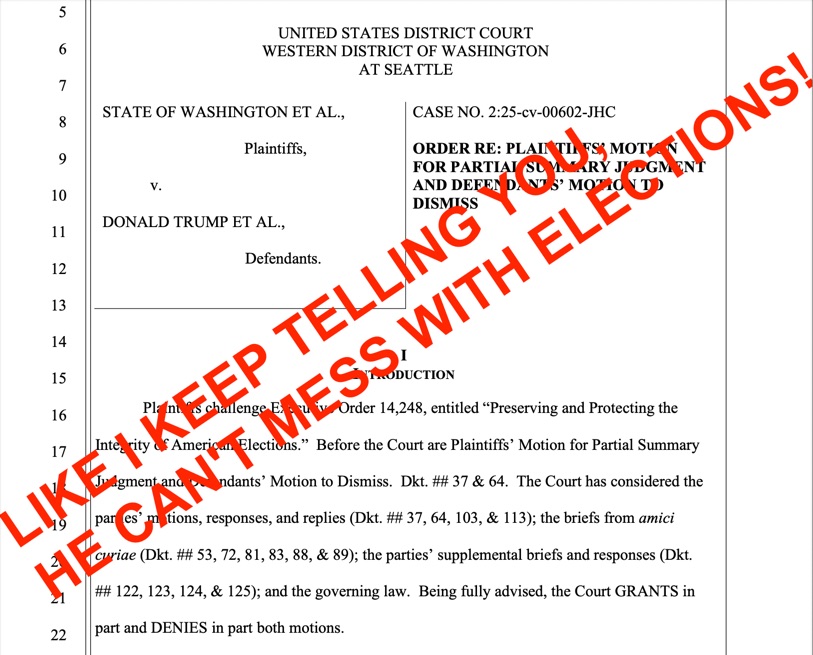
Source