STOP SAYING THAT THE PRESIDENTIAL IMMUNITY DECISION “NEEDS TO BE OVERTURNED” – *HERE* IS HOW IT NEEDS TO BE ATTACKED
I’ve noticed an increase in people saying “The Supreme Court’s presidential immunity decision needs to be overturned.”
Exactly *what court* do they think is going to overturn it? The Supreme Court is the highest Federal court in the land – that’s why it’s called the Supreme Court.
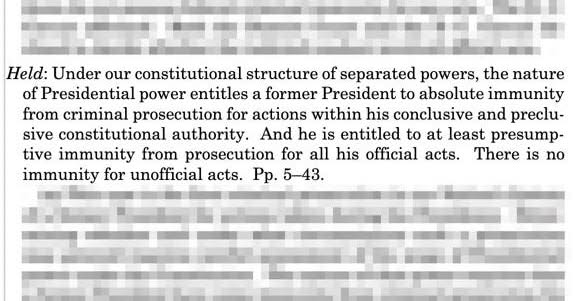
But here’s the thing: it’s *very* important to remember that what the Supreme Court *actually* said in that decision was this:
“Under our constitutional structure of separated powers, the nature of Presidential power entitles a former President to absolute immunity from criminal prosecution for actions within his conclusive and preclusive constitutional authority. And he is entitled to at least presumptive immunity from prosecution for all his official acts. There is no immunity for unofficial acts.”
Here’s the important bit that many (especially the frenzy-whipping media) have conveniently overlooked:
“…within his conclusive and preclusive constitutional authority.”
His *constitutional* authority.
This means that you have to look at what authority and power the Constitution gives the president. And if you don’t consider that, and you are a member of the media, shame on you for going off half-cocked (and ‘half’ is being generous).
Here’s the other bit that the media conveniently overlooked: The *very narrow question* before the Supreme Court was this: “Whether and if so to what extent does a former President enjoy presidential immunity from criminal prosecution for conduct alleged to involve official acts during his tenure in office.”
“… for conduct *alleged to involve official acts* during his tenure in office.”
You can’t blame the Supreme Court for how the case came up, and the question presented. If the question before the Court was “Does a former president enjoy presidential immunity for acts that were alleged to be outside of his core constitutional powers” it may have been a very different decision indeed.
But the question that the Supremes were asked to answer had to do with conduct alleged to involve “official acts”.
To even begin to untangle this, you *must* look at Article II of the Constitution, which sets up the executive branch, and then must look at Section 2 of Article II, because *that* is the part of our constitution that spells out presidential powers and authority.
If it ain’t there, it ain’t “within his conclusive and preclusive constitutional authority”.
(Here “conclusive” means he absolutely can do the thing, and “preclusive” means he can stop the thing from happening.)
Here is Article II, Section 2, in its entirety:
“The President shall be commander in chief of the Army and Navy of the United States, and of the militia of the several states, when called into the actual service of the United States; he may require the opinion, in writing, of the principal officer in each of the executive departments, upon any subject relating to the duties of their respective offices, and he shall have power to grant reprieves and pardons for offenses against the United States, except in cases of impeachment.
He shall have power, by and with the advice and consent of the Senate, to make treaties, provided two thirds of the Senators present concur; and he shall nominate, and by and with the advice and consent of the Senate, shall appoint ambassadors, other public ministers and consuls, judges of the Supreme Court, and all other officers of the United States, whose appointments are not herein otherwise provided for, and which shall be established by law: but the Congress may by law vest the appointment of such inferior officers, as they think proper, in the President alone, in the courts of law, or in the heads of departments.
The President shall have power to fill up all vacancies that may happen during the recess of the Senate, by granting commissions which shall expire at the end of their next session.”
That’s it!
Also in that Supreme Court decision the Court observed that “If the President claims authority to act but in fact exercises mere ‘individual will’ and ‘authority without law,’ the courts may say so.”
In other words, if it isn’t granted to him in the Constitution, sue the bustard.
In order for the president to have absolute immunity, the act has to have been within his core constitutional authority. Anything else only has presumptive immunity (i.e. you have to overcome the presumption that it was an immune act) or no immunity at all.
So, the way to address this is to bring a legal challenge arguing that whatever the act is for which the lawsuit is being filed *was not within the president’s core constitutional powers”!
This is *exactly* how it’s supposed to work. This is *exactly* why our founding fathers, and the framers of our constitution, set it up the way that they did.
And finally don’t forget that this entire decision (included for Notes from the Front members, all 119 pages of it) was about *former* presidents and their immunity.
So all you people who are talking about having the presidential immunity decision “overturned” for *this* president, well,he’s not a former president (yet). Generally speaking presidents aren’t indicted while they are still in the Oval.
But once he is out of office, whooboyhowdy, let the lawsuits commence.
Notes from the Front members: the Supreme Court immunity decision is in your inbox.
To protect myself from legal claims of impermissible public republication, and attacks by trolls, among other things, I don’t share documents I find publicly, I make them available privately to Notes from the Front members, along with explanations and insights. You can join us below for immediate access to the document archives and our private chat – it’s $5 a month and it’s fine to join and then cancel if you only want certain documents.