
I HAVE THE HOMELAND SECURITY TRAINING HANDBOOK, THEIR USE OF FORCE HANDBOOK, AND THE FEDERAL LAW ENFORCEMENT TRAINING CENTER (FLETC) STUDENT HANDBOOK
Together these three manuals total 243 pages (Use of Force handbook is 113 pages, Homeland Security, the Training Handbook is 58 pages, and the Student Handbook is 72 pages). Notes from the Front members, the pdfs of all three are included for you.
Here’s the bit that I found most interesting and that led me down the rabbit hole that resulted in my finding all three handbooks:
The Use of Force Handbook is also known as ‘ICE Directive 19009’.
THE PUBLIC-FACING PAGE ON THE ICE SITE FOR 19009 HAS *ALL OF THE PAGES REDACTED*!!!
Then there is this notice in the Federal Register, from just three days ago, a motion that “SEC. 239. The Director of U.S. Immigration and Customs Enforcement (ICE) shall republish ICE Directive 19009 in full without redactions to reestablish mandatory procedures and protocols concerning firearms and the use of force by ICE employees.”
Remember, I have all three, including the full 19009 Use of Force Directive Handbook.
The below is an excerpt from the Use of Force Handbook regarding the “ICE Use of Force Continuum”; I suspect that you’ll find it interesting.
1) The ICE Use of Force Continuum describes and categorizes the application of various levels of force an Authorized Officer may use to gain control over a resistant subject.
2) An Authorized Officer may have to rapidly intensify or diminish force and employ varying use of force options through the Continuum, depending on the totality of circumstances present and the evolving situation.
3) Outlined below are the 5 levels of the Continuum (with associated non-exhaustive examples of each):
a) First level (Officer Presence):
i) Professional, courteous demeanor;
ii) Positive attitude; physical condition;
iii) Confident posture and body language; and
iv) Professional attire, or clean, neat attire appropriate to the work being performed.
b) Second level (Verbal Commands):
i) Professional, firm voice;
ii) Instructions that are simple, easy to understand, and repeated as necessary; and
iii) Only one officer issuing verbal commands at any given time.
c) Third level (Soft Techniques): i) Empty-hand techniques with a minimal chance of injury;
ii) Escort position;
iii) “Come-along” holds, to include the use of impact weapons that involve the application of pressure to move noncompliant subjects;
iv) Use of touch pressure points; and v) Use of chemical agents.
d) Fourth level (Hard Techniques):
i) Techniques that have a greater possibility of injury to subjects;
ii) Strikes with a hand, arm, foot, leg, head, or the whole body;
iii) Throws;
iv) Take-downs;
v) Specified EMDDs;
vi) Impact weapons when used for striking; and
vii) Specialty impact weapons.
viii) Canine Release
e) Fifth level (Deadly Force):
i) Discharge of firearms against persons or animals;
ii) Any use of impact weapons to strike the neck or head;
iii) Any strangulation techniques;
iv) Any strikes to the throat; and
v) Use of any edged weapons.
—
Notes from the Front members: All three handbooks are in your inbox now.
NOTE: To preserve original source documents before they can be tampered with, and to protect myself from claims of improper republication, and hey, the trolls, I make documents I find (and at times purchase out of my own pocket) privately available to Notes from the Front members. Often these are non-public documents, others may be public but I find the source originals for you and include explanations and insights based on my decades of law practice and as a law professor, with a side of snark. ;~)
You can join below for immediate access to this and other documents, the archives, and our private chat for $5 a month.
https://annepmitchell.substack.com/p/i-have-the-homeland-security-training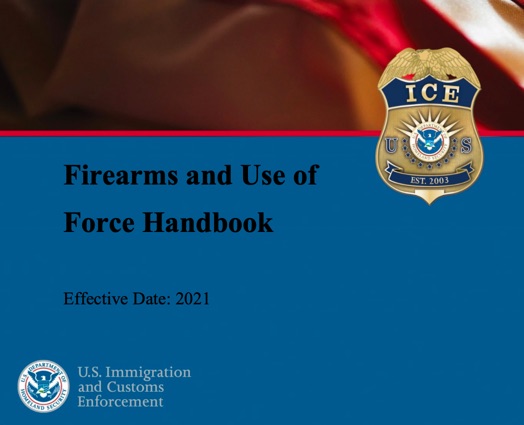
Source